
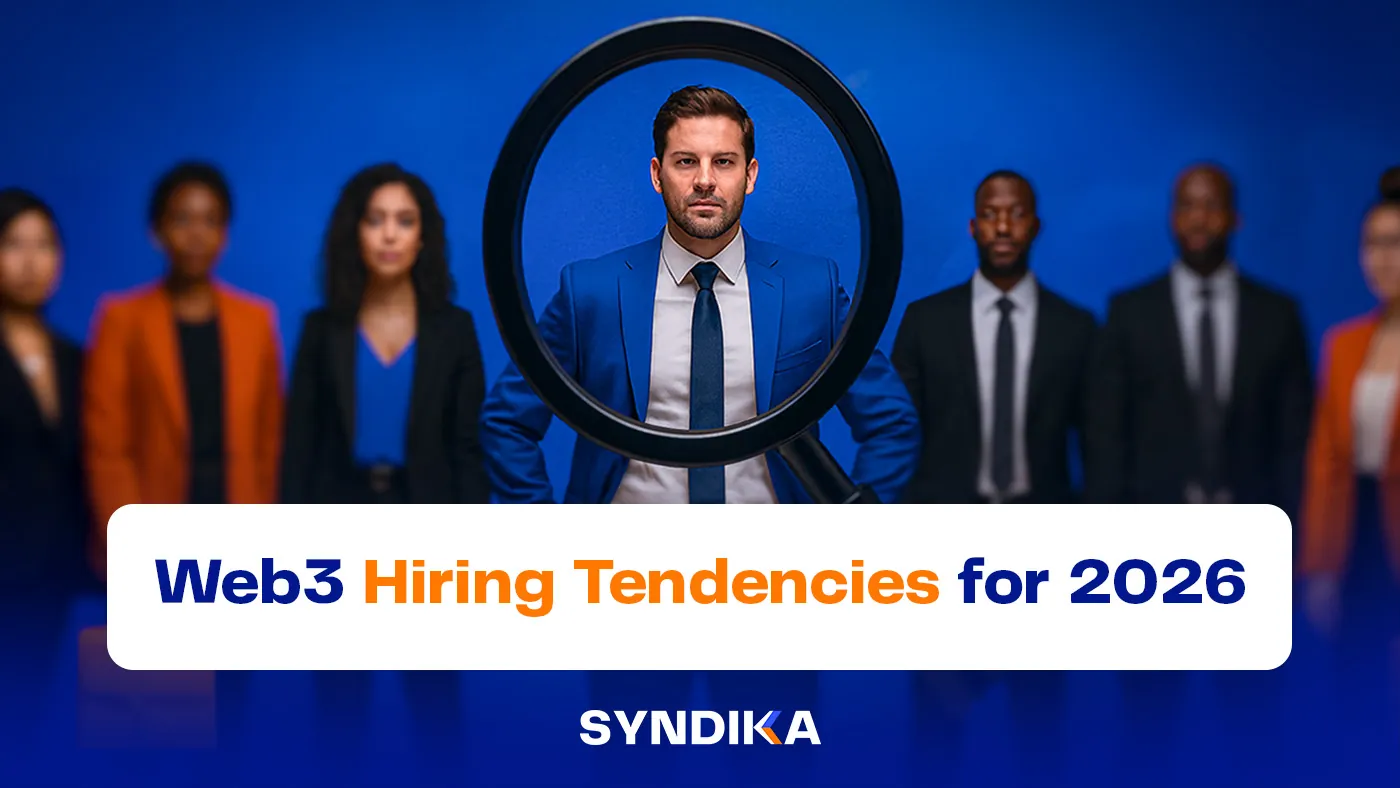
In 2025, the blockchain-related roles posting grew by around 45%. This clearly shows that the Web3 job market is growing, becoming less experimental and more about long-term building.
At the same time, hiring itself is becoming “on-chain native”: our friends from Up Top saw nearly 1 in 5 invoices paid in stablecoins, meaning blockchain is not just what teams build on – it’s also how they get paid.
As we move into 2026, together with our partners from Up Top and Bondex, we prepared a Web3 career guide exploring 6 trends that will define Web3 hiring next year.
What are they? Check out our quick guide.
1. Tech talent in high demand
2025 showed that specialized talent is now the backbone of Web3 hiring. Half of all crypto jobs were technical or highly specialized, with companies investing in deep expertise across engineering, AI, and security disciplines.
We believe that this trend will keep growing in 2026, with these roles being on top:
Blockchain developers
In 2025, blockchain engineers fluent in Rust, Go, and Solidity and experienced within ecosystems such as Ethereum, Solana, and Hyperledger were in high demand. Equally important was architectural knowledge of consensus systems, zero-knowledge proofs, and layer-two scaling frameworks across networks such as Ethereum, Solana, Cosmos, and Polkadot, combined with the ability to build full-stack decentralized applications using IPFS, Filecoin, Node.js, Web3 libraries, and modern front-end frameworks.
Syndika’s IT recruiter lead, Ksenia Vorchuk, adds that “in 2025, our main focus was on hiring experienced developers at the Middle+ level. During interviews, we placed the greatest emphasis on real hands-on experience rather than just theoretical knowledge. I think that next year the key competencies for Web3 developers will be flexibility, the ability to combine technical expertise with AI tools, and rapid adaptation to new standards.”
Security specialists
With the strong development of AI in 2025, DeFi solutions faced increasingly sophisticated attacks, and blockchain security specialists have become essential. Companies now actively seek experts in threat modeling, smart contract auditing, and cryptography, with the strongest candidates demonstrating efficiency in fuzz testing, auditing, threat modelling, and tools like Echidna, MythX, and Sither.
Blockchain C-Suite roles
In our experience, another visible shift heading into 2026 is the rise of executive blockchain job openings. Blockchain is emerging as a separate strategic pillar of a Web3 startup that has driven the creation of titles such as Chief Blockchain Officer and Head of Blockchain Strategy – roles that exist not to write code but to build and execute the project’s blockchain strategy.
2. The quiet rise of non-technical hiring
As Web3 community growth and marketing are developing, becoming more professional and requiring strong management skills, in 2025, we saw our portfolio teams hiring more product managers, marketing leads, or operations specialists as aggressively as developers.
Since regulation has become stricter and more selective towards crypto companies this year, the regulatory pressure has also contributed to the growth of such positions as legal and compliance experts in blockchain. People who understand crypto-specific regulation are now among the most difficult hires in the industry, and we believe so will be in 2026 too.
“Institutional BD is becoming critical in crypto, especially with policy shifts; teams need people who can speak to major institutions and bring in real TVL,“ adds Joe Zammit, a Talent Partner at Up Top.
3. New growth of roles that we did not know would rise
In 2025, entire crypto job categories emerged that barely existed in previous market cycles. AI prompt engineers now operate inside DeFi analytics and trading environments. Tokenomics specialists design sustainable incentive structures rather than speculative emissions models. Community managers operate as ecosystem architects rather than moderators. DAO governance specialists work full-time on coordination, proposal design, and decentralized decision-making at scale.
The message is clear: Web3 is no longer built only by engineers. It is also built by people who make Web3 what it is now: community and AI-driven. Expect these roles to grow in price and demand in 2026, too.
4. AI integrating more into Web3
As of 2025, ≈ 78 % of companies worldwide reported using AI in at least one business function.
And we see this tendency across multiple business departments of a Web3 company, too. Engineers use AI from code writing to contract analysis and verification. Business teams use AI to manage clients. Marketing teams use it to automate engagement, manage sales, and predict user behavior. Content creators and top management leverage all the benefits of ChatGPT and other AI tools that help master their message.
Candidates who understand both AI systems and blockchain protocols are quickly becoming the most valuable hires in the market.
“The market is rewarding ‘T-shaped’ talent, perhaps more than ever. Deep expertise in either AI or blockchain, plus credible working fluency in the other, is often more realistic than expecting lots of true dual-specialists. The most expensive and scarce profiles are not general “AI + Web3,” but AI-augmented security engineers, protocol architects who use AI effectively, and product leaders who can deploy agentic workflows safely,” adds Ignacio Palomera, the Founder of Bondex.
At the same time, Ksenia Vorchuk from Syndika warns HR managers and recruiters that the power of AI has its downsides. “We are already seeing a new challenge: candidates are actively using AI during interviews. For recruiters and tech leads, this adds another layer of difficulty – it becomes necessary to distinguish real expertise from AI-generated answers,” says Ksenia.
5. Talent shortage that started several years ago
Despite the growing demand for tech specialists, HR and recruitment specialists report that candidates with the right expertise are hard to find. Many candidates may understand crypto conceptually, but far fewer have deployed smart contracts at scale, led audits, designed token economies, or navigated regulatory frameworks in live environments.
The shortage is also acute at the senior level. Web3 companies are not just looking for coders, but for architects who can prevent exploits and make critical technical tradeoffs under pressure.
Ignacio Palomera from Bondex also says that “the bottleneck here is senior execution. While overall crypto developer counts dipped in 2024, established developers reached all-time highs and contributed the majority of code. Combined with ongoing security losses across the Web3 ecosystem, demand has shifted from ‘more coders’ to architects and auditors who can ship safely under adversarial conditions.”
Another issue here is the inability of many good specialists to relocate. Joe Zammit from Up Top confirms that “an overlooked constraint is the scarcity of candidates open to in-person roles. The strongest operators in crypto rarely relocate, yet everyone wants someone in NYC – which leaves teams tied to physical offices at a clear disadvantage.”
6. Salary & compensation pressure
Yes, Web3 currently lacks specialists with real experience in Web3. However, this demand for crypto-native professionals leads to the compensation expectations that continue to climb.
Moreover, Web3 companies are no longer competing only with other crypto firms. AI startups and traditional financial institutions, to name a few, are expanding into digital assets. This has placed sustained upward pressure on Web3 salaries.
At the same time, retaining talent has become as difficult as hiring it in blockchain. Competitive compensation packages now extend well beyond base salary and commonly include token allocations, flexible remote policies, or governance participation.
Final Thoughts
The hiring narrative for Web3 companies and hiring agencies in 2026 is not “crypto is back.” It is “crypto is becoming mature.” Speculation is giving way to structure. Exploration is giving way to accountability. The industry is extensively hiring experienced tech builders who know how to grow a Web3 startup under real-life pressure. On the other hand, the crypto market, as usual, is going from bear market to bull market, and vice versa.
Anastasia Ilyicheva, an HR Manager from Syndika, says: “The generations entering the workforce are changing. This demands tech companies to rethink how we define roles and search for talent – so our expectations truly match today’s reality. “
The Web3 companies should understand the big picture, not to chase talent, but to improve their strategy and techniques of hiring the right people.
Web3 Startup Funding Trends: What Investors Will Look for in 2026
Q3 2025 saw nearly $4.65 billion in venture capital poured into crypto and blockchain projects. However, that figure is increasingly carried by a small number of large, late-stage rounds rather than broad bets on whitepapers. These stats clearly show that investing in Web3 is shifting from riding the hype wave to the era of “real […]

Read more
13 Common Crypto Security Mistakes And How To Avoid Them
According to the report made by Kraken in October 2025, while 95% users admit that they use at least one safety measure to protect their crypto assets, “many still reuse passwords or store seed phrases insecurely.” In a recent article, we explored how Web3 founders can protect their Web3 startups from crypto scams and fake […]
Read more

User Acquisition in 2025: Data-Driven Strategies for Web3 Projects
Web3 founders are finally realizing that airdrops, giveaways, and X comments don’t buy users; they just buy noise. The only metric that matters is the number of people who come back, contribute, and stay. A study by Keyrock, analyzing 62 airdrops across six blockchains in 2024, showed that only eight delivered positive returns after 90 […]
Read more
