
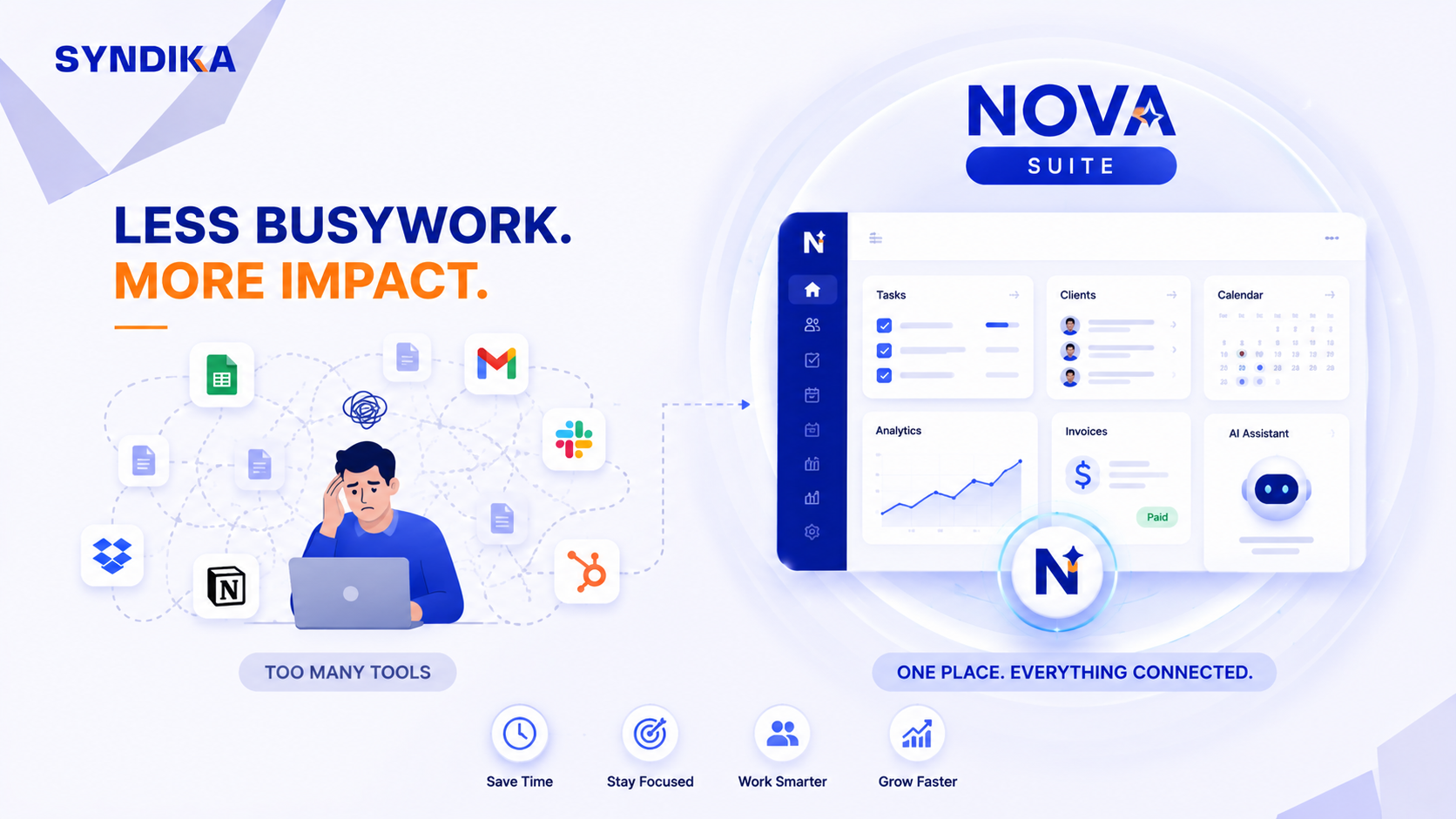
Running a business often means spending surprisingly little time on the work that actually moves it forward.
Instead, owners and teams spend hours checking emails, updating spreadsheets, following up with clients, searching for information, moving files between systems, preparing reports, and making sure routine tasks haven’t been forgotten.
None of these tasks are necessarily difficult. The problem is how often they have to be repeated.
This is where AI can have a practical impact—not by replacing professional expertise, but by reducing the amount of routine coordination that surrounds it.
The hidden cost of switching between tools
Most businesses already have software for almost everything: accounting, CRM, email, calendars, documents, communication, project management and reporting.
The challenge is that these tools often operate separately.
A client might be in the CRM, an invoice in the accounting system, a request in email, and the next task sitting in a spreadsheet.
The employee becomes the connection between all of these systems.
That creates a lot of small tasks:
- Finding information in different applications
- Copying information from one system to another
- Checking whether someone has responded
- Following up on outstanding items
- Preparing recurring reports
- Updating records manually
- Monitoring deadlines and overdue tasks
Individually, these tasks take minutes. Across a team and an entire year, they can consume a significant amount of working time.
The opportunity for AI isn’t simply to make each task faster. It’s to reduce how many of these tasks people have to perform manually.
What Nova Suite is designed to do
Nova Suite is an AI command center for small and medium-sized businesses. Instead of asking teams to replace all their existing software, Nova connects with the tools they already use and brings important information and actions into one interface.
The idea is simple:
See what matters → ask for what you need → let AI handle the routine → keep people in control.
Nova can bring together information such as cash flow, invoices, clients, HR information, tasks and business issues into a single view. It can also respond to requests in natural language and carry out approved actions across connected systems.
That changes the role of business software from something employees constantly have to check into something that can actively help them manage their workload.
From “Where is that information?” to “Just ask.”
One of the biggest advantages of an AI-first interface is that employees don’t always need to know where information lives.
Instead of opening several systems to answer a question, they can ask for it in plain language.
For example:
“Which clients haven’t completed their forms?”
Or:
“Who on the team is behind on their tasks?”
Or:
“Send a reminder to everyone who hasn’t signed.”
Nova is designed to pull information across connected tools and, where appropriate, execute the requested task with user approval.
This may seem like a small change.
But removing dozens of small searches, clicks and handoffs from a working day can have a meaningful effect on productivity.
Accountants are a good example
Accounting firms are particularly interesting because so much of their work combines professional expertise with repetitive operational processes.
An accountant’s expertise is valuable when interpreting financial information, advising a client or identifying a business issue.
It is much less valuable when they are:
- Chasing missing documents
- Renaming and filing files
- Checking whether clients submitted information
- Sending repetitive reminders
- Preparing recurring reports
- Updating information across systems
AI can help separate the two.
For example, Nova can automate recurring tasks, monitor outstanding items and work with information across accounting and business tools. It can even handle certain workflows involving desktop applications and legacy systems where a modern API isn’t available.
The goal isn’t to automate the accountant.
It’s to automate everything around the accountant that doesn’t require an accountant.
Who else can benefit?
The same principle applies far beyond accounting.
Professional services
Law firms, consultants, agencies and other professional-services businesses often spend significant time managing documents, clients, deadlines and follow-ups.
AI can reduce the administrative layer around client work, giving professionals more time for analysis and relationships.
Real estate
Real estate teams manage large amounts of client communication, documents, follow-ups and scheduling.
A connected AI system can help monitor outstanding actions and automate routine communication.
Small business owners
For an owner, the biggest problem is often not one specific task.
It’s having to keep track of everything.
Which client needs attention?
Which invoice is overdue?
Who hasn’t completed their task?
What’s happening with this week’s priorities?
Having this information surfaced in one place can reduce the mental overhead of running the business.
Operations teams
Operations professionals spend much of their time coordinating information between people and systems.
AI can help monitor processes, identify exceptions and automate recurring workflows.
Service businesses
Businesses with recurring appointments, client requests, forms, payments and follow-ups can benefit from automating the repetitive steps that happen around every customer interaction.
AI doesn’t have to mean replacing people
There is a common misconception that the value of AI comes from replacing human work.
In many businesses, a more useful approach is to ask:
Which parts of this process actually require human judgment?
Everything else is a candidate for automation.
Nova’s model reflects this principle. It can suggest actions, execute routine tasks and run scheduled workflows, while keeping the user in control of important decisions and approvals.
That distinction matters.
A business doesn’t necessarily need AI to make every decision.
It needs AI to make sure its people aren’t spending their day making decisions about things that don’t require much decision-making.
The real advantage: fewer interruptions
Productivity isn’t only about completing tasks faster.
It’s also about reducing context switching.
Every time someone moves from email to CRM, from CRM to accounting software, from accounting software to a spreadsheet, and then back to email, there is a cognitive cost.
An integrated AI layer can reduce those interruptions by bringing information together and allowing users to interact with multiple systems through one interface.
Nova currently supports integrations across business tools including accounting platforms, CRM systems, email, calendars, storage, communication and project-management tools.
The result isn’t necessarily a dramatic transformation overnight.
It’s hundreds of small moments throughout the day where someone doesn’t have to search, copy, check, remind or repeat.
And those minutes add up.
The future of business software may be less about more tools
Businesses don’t necessarily need another application for every problem.
They need their existing systems to work better together.
That’s where AI can become more than a chatbot.
It can become a coordination layer between people, information and software.
The most useful AI may not be the technology employees notice the most.
It may be the technology that quietly removes 20 small tasks from their day.
Less time managing the work. More time doing the work that matters.
Explore – nova-suite.ai
